The Model We Can't Have vs. The Model They Can't Take
Days after Washington pulled Anthropic's most capable model offline, a Chinese lab shipped open weights nearly as good and told us to keep them forever. That contrast is going to define the next few years.

Days ago, the most capable coding model I'd ever used (by a wide margin) was pulled off the internet by the U.S. federal government. This week, a Chinese lab, Z.ai, handed us open weights for a model benchmarking nearly as good, and told us we can keep them forever. That contrast is going to define the next few years.
GLM-5.2 is Real Competition for Opus
Z.ai shipped GLM-5.2 on June 13th, and the headline numbers are genuinely hard to wave off. It lands just 1% behind Claude Opus 4.8 on FrontierSWE, the long-horizon coding benchmark I actually care about, and edges out GPT-5.5 by a hair, at roughly one-sixth the cost. It's a ~750B-parameter mixture-of-experts model with only ~40B active at any time, a usable 1M-token context window, and two thinking-effort levels you can dial per request. API access runs $1.40 per million input tokens and $4.40 per million output. There's a $18/month subscription tier if you'd rather not touch the API at all.
Nevertheless, this model's cost efficiency remains attractive, especially given the economic worry about reduced token subsidization as frontier firms pursue IPOs and struggle to show profitability.
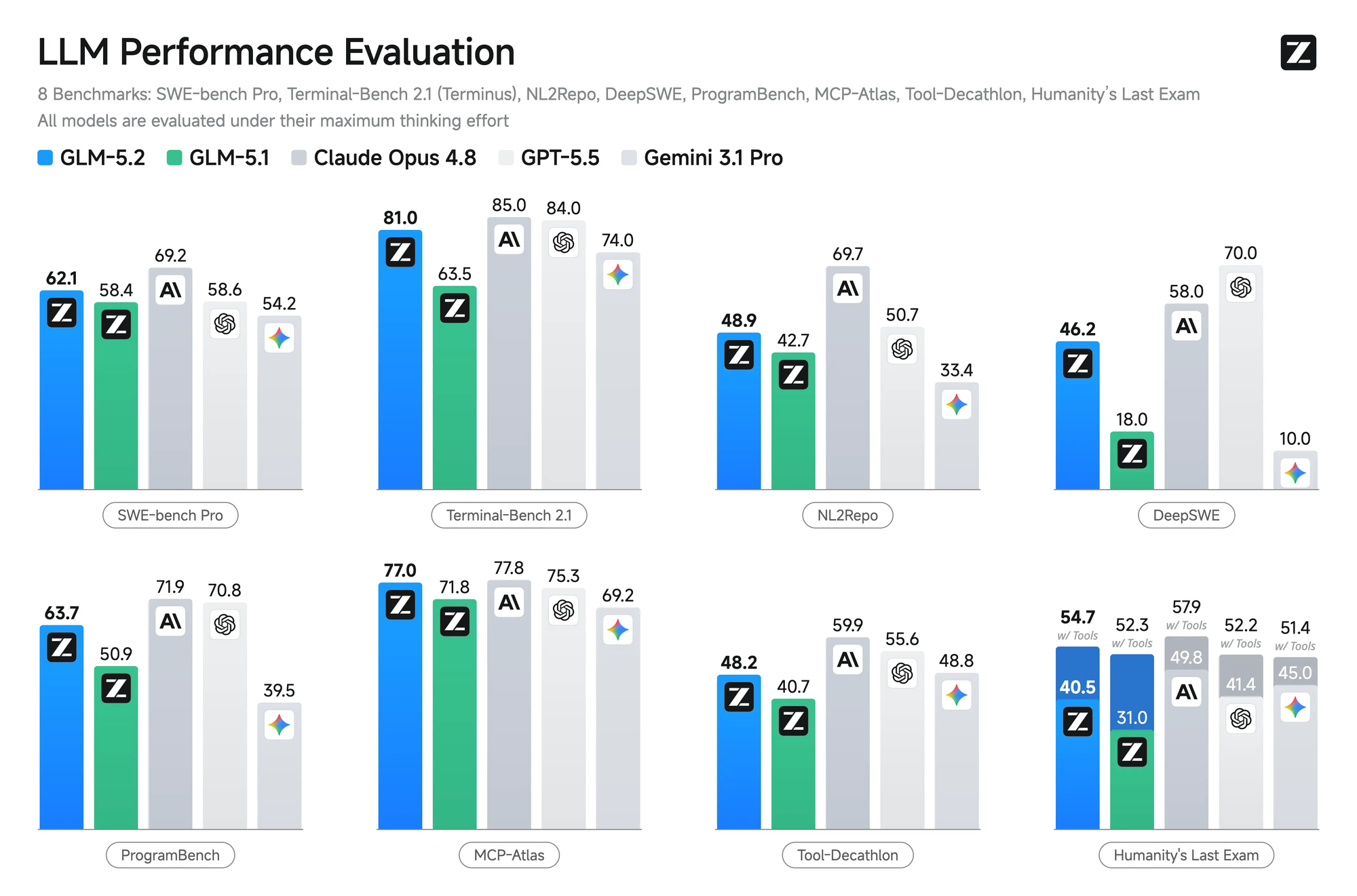
While benchmarks are fun to stare at, more importantly, the weights are live on Hugging Face under an MIT license. This is not a research-only license or a "non-commercial unless you call it sales" license. Under MIT license, you can download, run, fork, fine-tune, embed it in a product, or take it offline into an air-gapped vault. No one can revoke these rights.
Timing is Everything
GLM-5.2 was released days after the U.S. government forced Anthropic to take Fable 5 and Mythos 5 offline, the same Fable/Mythos line I was writing about a week ago as the frontier of superautonomous coding.
If you missed it: on June 12th, an export-control directive prohibited foreign nationals, including foreign Anthropic employees inside the U.S., from accessing both models. Given the absurdity of this order and their inability to quickly and reliably identify who the Americans are, Anthropic was forced to shut off access for everyone. As far as I can tell, this is the first time a leading lab has taken a publicly deployed model offline because a government required them to do so. As of this writing, it remains inaccessible to everyone.
The trigger, if the reporting holds up, is almost comically small: a jailbreak that reportedly hinges on three words — "fix this code", surfaced by researchers at Amazon. Anthropic's own response is worth quoting, because they're not wrong: governments should be able to block unsafe deployments, but only "as part of a statutory process that is transparent, fair, clear, and grounded in technical facts," and this action "does not adhere to those principles."
Nobody Should be Surprised Right Now
Back in March, in Three Agentic Open-Weight Models I'm Paying Close Attention to, I wrote that I dreaded "the game of musical chairs our entire industry is playing with the AI behemoths and their supporting cast," and that it "could come to an abrupt stop at any moment."
Previously, the failure mode I had in mind was boring and commercial: a price hike, a rate limit, a quiet model deprecation, a startup getting acqui-hired into oblivion. I did not have "the U.S. government issues an export-control directive and a frontier model evaporates in a weekend" on my bingo card.
The current administration seems more interested in hindering America's progress in AI and interfering with capitalism; in doing so, it's disregarding its own historical principles to boost egos and sway markets in its favor.
Also, consider which lab was on my March list. GLM was one of my three, and it's a Chinese AI lab. They've been a consistent competitive player this whole time, and these stupid policy moves are ceding the race to them.
Openness is ultimately about risk management. Any dependency you cannot inspect, host, or maintain leaves control in someone else's hands, including the ability to turn it off.
This is also why I keep banging the same drum I hit in The Claude Code Source Leak Revealed More About Us Than Anthropic.
It's Past Time to Prepare For Supply Chain Disruption
A model you access through an API, however brilliant, is a capability you rent, and the guarantees are sparse. It's subject to the lab's roadmap, the lab's pricing, the lab's terms, and now, demonstrably, the lab's government. A model whose weights sit on your own disk under an MIT license is a capability you own. It will run the same way next year as it does today, regardless of who's mad at whom.
For most of my agentic work, Opus 4.8 is still the sharpest tool in the drawer and priced reasonably well; it stays my daily driver. GLM-5.2 just moved the cost of insurance down to nearly zero.
When a near-frontier coding model is open, cheap, and ungovernable by third parties, "have a self-hosted fallback that's genuinely good" stops being a prepper fantasy and becomes basic operational hygiene.
Fable demonstrated these downsides in a visceral way. GLM-5.2 appears as the hedge emerging in the same news cycle. This timing seems more like a glimpse of what the next few years will look like: the frontier will continue to be rented out and sometimes repossessed, while the open, ownable, self-managed space beneath it will keep increasing in value.
About the author

Derek Perez is the Founder & Principal Technologist of Limbic Systems, a software consultancy that partners with organizations to design and deploy AI-native software and systems — without losing the human judgment that keeps them grounded. After over a decade of hands-on experience building startups and leading high-performing teams at Google, he partners with founders and operators who need both technical depth and business acumen to navigate what's next. Find him on LinkedIn and Bluesky, or by email: derek@limbic.systems.